Category Archives: Esports

Boom Sports gets Penn National iGaming skins, Barstool arrangement

Penn National has come to an agreement with New York-based Boom Sports for the latter to operate a number of iGaming skins for the casino operator across the U.S. According to a press release from Boom Sports from yesterday, the partnership will see it operate mobile sportsbooks and online casinos through the deal, which will remain in place for 20 years once each state signs off on the arrangement. In addition, the company will launch a new product tied to Barstool Sports, which was acquired by Penn National this past January for $450 million.

The new agreement allows Boom Sports to provide its own digital sports gambling and iCasino products under the Penn National umbrella in five states, including Louisiana, Mississippi, Missouri, New Mexico and Ohio. In Mississippi and Louisiana, the company will hold first skins; in Ohio, a second skin and Missouri and New Mexico will be home to third skins. Boom Sports will also be open to exploring additional operations in other states.

Boom Sports co-founder and CEO Stephen A. Murphy says of the deal, “This agreement marks a pivotal moment in the history of Boom Sports. As we aim to become the premier technology provider for the real-money online gaming industry, this deal will allow us to unveil our unique sportsbook vision directly to consumers.”

The deal is made even more lucrative for the company, as it doesn’t have to pay anything to Penn National in advance. In return, it will develop a collection of free-to-play games for the casino operator, one of which has already been introduced. That was NASCAR Finish Line, which was presented this past February to car racing fans and is designed to showcase live NASCAR races and eNASCAR competitions. Boom Sports has also agreed to create real-money games and content for Penn National.

Calvin Ayre Foundation donates millions in Personal Protective Equipment to help fight Covid-19

St. John’s, Antigua – Tuesday, April 21, 2020: The Calvin Ayre Foundation (CAF), announced today, that over EC$4 million worth of Personal Protective Equipment (PPE), is en route to Antigua and Barbuda from The People’s Republic of China, to assist the government in its fight against Covid-19.

According to Chairman of the Ayre Group, Ambassador Calvin Ayre: “As Antigua and Barbuda and many other small island developing states struggle to protect their citizenry from this highly contagious and deadly coronavirus, it is becoming painfully obvious that we cannot look to the traditional donors and trading partners for assistance in providing urgently needed PPEs.”

For example, effective Friday, April 10, the Federal Emergency Management Agency (FEMA), issued a temporary rule stating that it would be allocating “certain scarce or threatened materials for domestic use, so that these materials may not be exported from the United States without explicit approval by FEMA.” The rule covers five types of protective equipment including N95 masks, surgical masks and gloves. This decision leaves vulnerable countries like Antigua and Barbuda with no choice but to seek to acquire supplies from other source markets.

“Thankfully,” Ayre said, “we were able to procure the desperately needed protective equipment from China for our front-line workers in Antigua and Barbuda.”

How could AI change PPC advertising in the gaming industry

This is a guest contribution by Paul Torzel of Newbettingsites.uk. If you would like to submit a contribution please contact Bill Beatty for submission details. Thank you.

When Google first introduced their AdWords program to us in 2000, all processes were completed manually. That has changed over time, with Google layering automated processes over the top.

Google AdWords, in some ways, were the invention of online advertising as we know it and these early steps paved the way for a successful future. It was an announcement in 2016 when Google CEO Sundar Pichai first announced that the world we live in would soon be known as an AI-first world.

Taking steps to ensure his company kept up to date with where we were heading, he said that Google would become an AI-first company.

Becky’s Affiliated: Innovation in digital event organizing with Pierre Lindh

Coming up May 4-6, iGaming NEXT will be launching their very own digital event, “The Big Reset”, addressing how iGaming professionals are adapting to a new digital norm, both from a personal and professional perspective.

[youtube https://www.youtube.com/watch?v=jchpns58GQc?feature=oembed&w=500&h=281]

Pierre Lindh, Co-founder and Managing Director of iGaming NEXT, views digital events as an opportunity for innovation and change for an industry that has been stuck in time for several decades.

Due to the nature of digital events, tickets are much less expensive than in-person events and without a travel commitment, many more people are able to attend. For this reason, Lindh decided to do things a little differently for the upcoming digital installment of iGaming NEXT.

Las Vegas Sands loses $55m in Q1 but Adelson doesn’t lose heart

Casino operator Las Vegas Sands reported a rare net loss in the first quarter of 2020 but the company’s braintrust insists things are nowhere near as bad as they seem.

Figures released Wednesday show Sands generated revenue of $1.78b in the three months ending March 31, a 51.1% decline from the same period last year. Adjusted earnings were down 70% to $437m, operating income fell 94.3% to $55m and the company booked a net loss of $51m versus a $744m profit in Q1 2019.

The figures reflect the 15-day COVID-19 shutdown of all Macau casinos in mid-February and the market’s glacially slow recovery ever since. Sands China’s revenue was down 65% to $814m while the unit posted a net loss of $166m versus a $557m profit last year.

Sands’ Macau properties all posted significant declines in VIP gambling turnover, including a nearly 70% downturn at the company’s flagship Venetian Macao.

Goa’s casinos get yet another six-month stay of execution

Casinos in the Indian state of Goa are starting to treat the local government like a dentist, in that they’re constantly told to come back and see them in six months.

On Wednesday, Goa’s state government approved yet another six-month extension of the six floating casinos’ right to operate on the Mandovi river. The previous six-month stay of execution expired on March 31 and the casinos now have until September 30 to find somewhere else to ply their trade.

Various versions of Goa’s government have been trying to find an alternate waterway for the floating casinos for the better part of a decade but every proposal meets with opposition from local residents. The casinos are supposed to eventually relocate to a designated land-based gaming zone, although those plans are similarly ill-defined.

The situation took a left-turn last October, when the City of Panaji announced that inaction was no longer an option and it wouldn’t renew the floating casinos’ business licenses when they expired in March. The City has yet to comment on Wednesday’s news, but Panaji MLA Antanasio Monserrate said he would continue to press for the casinos’ relocation “as was promised to the people of Panajji.”

BC casino cities want cut of PlayNow online gambling revenue

British Columbia’s gambling monopoly is being asked to share its online gambling riches with local municipalities now that the province’s casinos have all been closed by COVID-19.

On Tuesday, Arjun Singh, a councillor in the city of Kamloops, told his fellow councillors that an unidentified source at the British Columbia Lottery Corporation (BCLC) had told him that the Crown corporation’s online gambling site PlayNow.com had seen its business ‘increase significantly’ following the pandemic-related closures of BCLC’s casinos.

On March 16, BCLC ordered all casinos, community gaming centers and bingo halls in the province to close following directives issued by the provincial health authority. BCLC controls virtually all gambling in the province, although it farms out day-to-day operational control to third parties.

That closure has negatively impacted the finances of casino host cities like Kamloops, which has two shuttered gaming venues – Cascades Casino Kamloops and Chances Casino Kamloops – both of which are managed by Gateway Casinos & Entertainment Ltd.

Virginia pols okay amended casino, sports betting legislation

Virginia’s casino and sports betting proposals appear good to go after both chambers of the state legislature approved their governor’s last-minute amendments.

Wednesday saw both the Virginia Senate and the House of Delegates approve multiple amendments to the state’s casino and sports betting legislation, which authorizes mobile sports betting and the construction of up to five casinos, none of which is presently legal in the state.

The original legislation arrived on Gov. Ralph Northam’s desk last month, but Northam added several amendments to (a) hike gambling license fees, (b) ensure gambling tax revenue was allocated to education funding, and (c) include the state’s two NASCAR racetracks in the list of entities allowed to partner with bookmakers on a mobile sportsbook offering.

Casinos will pay 18% on their first $200m of annual gaming revenue, rising to 23% on revenue between $200m and $400m, topping out at 30% for revenue over $400m. Sports wagering revenue would be taxed at 15%.

NetEnt leans on Red Tiger, UK & US to offset Swedish decline

Online gambling technology supplier NetEnt is weathering the COVID-19 pandemic just fine thanks to UK and US market growth.

In a first-quarter earnings preview released Wednesday, the Stockholm-listed NetEnt said its revenue totaled SEK518m (US$51.2m) in the three months ending March 31, nearly 24% higher than the company reported in the same period last year.

Earnings were up nearly 17% to SEK229m and would have risen higher were it not for SEK26m in restructuring costs associated with the integration of software provider Red Tiger Gaming, which NetEnt acquired last September. Those costs, as well as earn-out obligations related to the acquisition, pushed after-tax earnings down by nearly one-third to SEK82m.

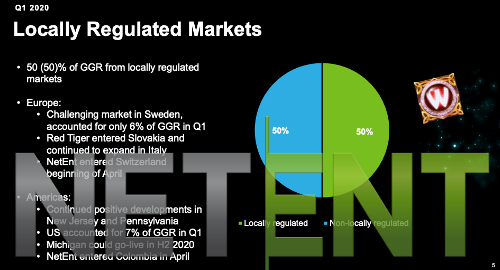
NetEnt CEO Therese Hillman said most of Q1’s growth came from the US and UK markets, which offset continued “negative” results in Sweden and Norway. Sweden’s share of NetEnt’s overall revenue has fallen to just 6%, while the US now accounts for 7% thanks to strong growth in New Jersey’s online casino market and the launch of regulated online casino in Pennsylvania.

Sweden’s online gambling ops cutting advertising spending

Sweden’s gambling operators continue to curb their advertising spending, while the local regulator has fined another online casino licensee for failing to observe proper self-exclusion protocols.

Figures published this week show online casino operator Cherry AB topping the list of Swedish-licensed gambling operators in terms of advertising spending in the month of March. Cherry ranked third on the list with a total outlay of SEK52.1m (US$5.15m), although this represented a nearly 59% decline from the same month last year.

State-run Svenska Spel ranked seventh on the list with an outlay of SEK42.3m, down nearly 50% from March 2019. Unibet’s parent company Kindred Group placed a distant 17th as its spending fell nearly two-thirds to SEK33.2m, while state-run racing and betting operator ATG placed 20th with SEK30m (-11.7%).

The gambling operators’ spending cuts are at least partially due to the suspension of most live sports events due to the COVID-19 pandemic. It’s perhaps not surprising then that Sweden’s Postcode Lottery made a push to grab some market share, resulting in its debut on the March chart in sixth place with ad spending of SEK42.4m.

Philippine gambling regulator renews push to restart online ops

Philippines-based online gambling operators are hoping the country’s president heeds calls to restart their operations if they adopt certain pandemic health protocols.

On Tuesday, local media reported that Andrea Domingo, chair of the Philippine Amusement and Gaming Corporation (PAGCOR), had written to President Rodrigo Duterte recommending that Philippine Offshore Gaming Operators (POGO) be allowed to resume operations “provided that all health protocols such as social distancing, wearing of masks, frequent and proper hand washing are observed.”

POGO operations were suspended in March as the country’s main island of Luzon was put under quarantine to limit further spread of the COVID-19 coronavirus. Most POGO service providers and live casino studios are based in Luzon’s largest city Manila.

PAGCOR recently announced that the shutdown of POGOs and land-based casinos – including PAGCOR’s own Filipino Casino operations – was depriving the regulator of $118m per month in lost revenue. PAGCOR is among the largest contributors to the government’s coffers, and Domingo previously asked if certain “high-earning” gambling segments might be allowed to resume operations so that the government doesn’t go broke.

Poker on Screen: Ace in the House (2007)

Each week, we take a look at a moment poker was on screen. Televised poker has a history that is as chequered as a chess board and as dramatic and ever-changing as poker strategy itself. While some concepts for bringing the game to the small screen flourish, like Poker After Dark or High Stakes Poker, others crash and burn, like this week’s example of TV poker gone wrong – 2007’s Ace in the House.

The idea of Ace in the House is one that screams to be commissioned. A popular poker pro heads to an amateur home game and tries to win the money on offer. On December 3rd, 2007, the Game Show Network put out the first and only episode of the show.

The poker pro in question was Mike ‘The Mouth’ Matusow.

The show did a decent job of building up the contestants and setting up the premise itself and it was a good idea. As you can see from the opening section of the show, everyone seems fairly happy.

World Series odds: Twins benefit from delay?

Odds courtesy of OddsShark.com

Some potentially good news last week regarding the chances there will be a Major League Baseball season at some point this year. Needless to say, owners and players are both going to do whatever it takes to play even 50-60 regular season games and a postseason because both sides would lose hundreds of millions of dollars if there’s no baseball in 2020.

Dr. Anthony Fauci, the top infectious disease expert in the United States and really the public face of battling the coronavirus, said he could see a way that sports could return this summer – he didn’t give a date and wasn’t going to make a prediction – and that’s if games are played in empty stadiums/arenas and the players are quarantined in hotels.

MLB seems to be looking at a plan to have all 30 teams play in Arizona, which has 10 spring training sites with ballparks, a few major colleges with fields and Chase Field – all in the greater Phoenix area.

Poker in Print: Dead Man’s Hand (2008)

Poker often features in crime fiction, but usually as a sideshow. The home game that is interrupted by news of an unforeseen death, the walkthrough of a casino after police tape has already been tied up around a crime scene, or the internet history looked up after a serial killer has run amok.

Rarely, however, is the game of poker integral to the plot of a crime story.

That is, except perhaps, in the short story collection called Dead Man’s Hand, a 2008 compilation edited and compiled by Otto Penzler with an introduction from Howard ‘The Professor’ Lederer.

Don’t let that FTP-scandal-tasting stamp of approval put you off. The volume contains 15 stories from some of the world’s best crime writers, such as Alexander McCall Smith, Walter Mosley, Joyce Carol Oates, Jeffery Deaver and Peter Robinson.

Operations teams can do more with better tools

We’re all blessed to live in the year 2020. Decades of iterative development have created powerful business tools, capable of making business operations more efficient.

That means more now than ever, with millions of employees locked at home, and being required to connect remotely to continue their work. In some ways, having everyone work from home may have made many people more productive even, as some of the unintentionally wasteful work habits have had to be dropped. I’m a big fan of the memes that popped up as shelter in place orders started.

Coronavirus showing us that every meeting could have been an email

— Ruth Millington (@ruth_millington) March 11, 2020

Does playing Esports games train your brain to be more attentive?

For many years, gamers have claimed that playing video games has made them smarter. Loosely, since the first 8-Bit computer games were popular, however, it has often been remarked by either parents or teachers that gamers are doing damage to their brains rather than good. The accusation that video games have bred violence is one that constantly comes up and yet is refuted by gamers just as regularly.

Finally, gamers in popular Esports such as Warcraft and Age of Empires can now lay claim to their brains being actively trained by the games that they participate in.

A new study carried out by the journal Frontiers in Human Neuroscience has revealed that regular gamers – Esports professionals being a good example of this – can process visual information faster than those who don’t play real-time strategy-based games. These games include titles such as Warcraft, Age of Empires or Total War.

In an interview in The Independent newspaper in Great Britain, Sally Guyoncourt reported that Dr Diankun Gong, the study’s author and Associate Professor at the University of Electronic Science and Technology of China said, “Or aim was to evaluate the long-term effect of experience with action real-time strategy games on temporal visual selective attention.”

nChain CEO: Experienced Bitcoin developers are in scarce supply globally

This is a guest contribution by Jasmine Solana, Associate Editor at CoinGeek.com. She interviews nChain CEO David Washburn, who explains that he doesn’t expect businesses to hire or become Bitcoin experts. Instead, they can turn to nChain for help. This article first appeared on CoinGeek.com.

Bitcoin is dead. It’s died more than a hundred times—if you believe the mainstream media, that is. The digital currency and blockchain industries, however, are far from dead; just take a look at the job market.

According to data from job search engine Indeed, job postings in the Bitcoin space jumped 1,457% during the September 2015-September 2019 period. LinkedIn also rated blockchain as the top “hard skill”—aka a skill companies need most—in 2020.

Blockchain “is the most in-demand skill in the United States, the United Kingdom, France, Germany, and Australia,” according to the job site.

SiGMA Group announces 3-day Digital Conference

Live conference will run from June 8-10 2020

SiGMA Group has announced the launch of SiGMA-ICE Asia Digital, which will run June 8-10 2020 for 3 hours daily, from 10AM – 1PM GMT+1.

Together with Clarion Gaming’s ICE Asia, the three-day conference will cater for both gaming and tech audiences, with free-of-charge content geared towards bringing the industry together in what has been a difficult time for businesses. Participants can expect land-based content on the 8th, while online gaming and emerging tech will cover the next two days respectively.

Founder and CEO of SiGMA Group, Eman Pulis said, “It is now more vital than ever to stay informed and connected, the digital conference will embrace the difficulties we are facing at a time when working together has never been more important. COVID-19 has provided a unique opportunity to stand together and rethink how we live and work.”

Nevada governor not ready to re-open state anytime soon

Las Vegas casino operators are going to have to be patient, and allow the COVID-19 pandemic to run its course a little longer. Governor Steve Sisolak, perhaps responding to those calling on him to start re-opening the economy, has declared that Nevada is in “Phase Zero,” and will need more time.

In a Carson City April 21 press conference, Sisolak announced he would extend the state’s shutdown, which was previously expected to end April 30. “We now want to move into a phase where saving lives and restarting our economy are not mutually exclusive,” he said.

The plan, state officials noted, is to observe 14 days of “consistent and sustainable” downward trends in the number of COVID-19 cases and hospitalizations, the Nevada Independent reports. With the state’s curve of infections still not entirely clear, experts note they’ll need a few more days to determine if they are on the downward slope. “We’ll be working to provide graphing material, as we move forward, and to be as transparent as we can,” Sisolak said

When pressed to provide a date the state might re-open, Sisolak refused, preferring to keep his options open. “The reopening needs to be flexible, because it’s going to rely on data, and this is a virus. There’s going to have some real time decision making, if we see a spike in cases.”

Money destined for “research” ends up supporting a Cyprus casino

Someone at the European Commission’s (EC) Research Executive Agency (REA) has a lot of explaining to do. Namely, how it was possible for a proposal for research money could be approved for a project that didn’t exist. Apparently, an organization had requested hundreds of thousands of dollars to fund forest fire research, which was approved. The money, however, was never used for its intended purpose and, instead, helped fund an unidentified casino on the Mediterranean island nation of Cyprus.

According to the Cyprus Mail, a “European consortium” comprised of five entities out of France, Ireland, Romania and Spain approached the REA with its idea. It was able to receive approval for more than €400,000 ($434,440) to fund its endeavor, but it was all a ruse. As the supposed project continued to move forward, the agency began to feel that something was off about receipts that were being submitted, and it reached out to the European Union’s anti-fraud division, the European Anti-Fraud Office (OLAF, for its French acronym), for some assistance.

OLAF launched an investigation that included spot checks and digital forensics to uncover more about the consortium and its activities. What it determined was that the group didn’t have the technical experience or background to conduct the research, and determined, in November of last year, that the consortium’s project was completely fabricated, from the initial request through the continued progress reports presented to REA.

OLAF was also able to determine that the money ultimately went to a casino project in Cyprus, but it didn’t specify which property was the recipient, or if it was even used for an existing project – it could have been meant to support a casino request in the country. The head of OLAF, Ville Itälä, is disappointed in the findings, and says, “With the EU focusing increasingly on environment and climate change, we have to make sure that money supposed to be used to improve our understanding of climate change and develop vital tools to help us tackle it, is used exactly for this purpose. With the Commission’s ambitious Green Deal, and the clear need to focus on the health, economic and social consequences of the current Coronavirus pandemic, we will need to ensure that EU money is properly spent. Now more than ever, every euro counts, and OLAF will continue to ensure it is properly accounted for.”