Category Archives: Esports

Per Norman named chairman in LeoVegas annual meeting

LeoVegas will be undergoing a number of changes in its corporate executive structure, and the biggest is that Per Norman will take over as the company’s new chairman. This was announced in the company’s notice for their upcoming annual general meeting, which will be held on May 8, 2020.

The new chairman has an impressive resume beginning with his time at MRG Group, where he was the Group Chief Executive from 2015-19. Most recently, Norman was the Chairman of Gamingzone AB, a Scandinavian esports entertainment platform and served on the board of Green Jade Games and Sverige Television Aktiegolag.

In addition to the naming of Norman, there were other appointments included in the release. IT expert Carl Larsson and Tortsen Söderberg were also named as company directors. They will work to support the new chairman. Larsson helped co-found DigitalRoute. Söderberg is a former member of the board at both Cherry Gaming and Stingbet.

There will be two members leaving the board as well. Mårten Forste and Tuva Palm chose to decline re-election, reducing the number of board members to seven directors.

Scientific Games brass takes pay cuts to fight coronavirus losses

With the casino industry being one of the hardest hit by the global outbreak of the coronavirus, casino operators and virtually everyone else tied to the market is being forced to find ways to scrimp and save until things can return to normal. Some companies, such as William Hill, found their leaders opting to completely forego compensation in order to help provide some relief to their employees. Others took a more self-serving route and opted to take shares in lieu of salary. Las Vegas-based gaming company Scientific Games (SG) has now announced how its top executives are responding to the COVID-19 disaster, with the company brass falling into the first camp.

CEO Barry Cottle is voluntarily giving up 100% of his salary, while others in upper leadership positions have agreed to take a 50% cut in compensation. While there is still going to be a need to reduce workforce hours, and possibly the level of employees for a little while, the company stands to release millions of dollars in the short-term to help ease the pressure felt by the global pandemic.

In addition, SG will also establish a Hardship Relief Fund for its employees and their families. This fund is designed to help cover any unexpected costs as operations scale back because of coronavirus, and will receive immediate support from SG’s revenue, as well as from Cottle and other senior executives.

The CEO explains in the announcement, “Like many others, our industry is facing unprecedented challenges from the widespread impact of the COVID-19 outbreak. We are working around the clock to take care of our employees, customers, shareholders and other key stakeholders in these difficult times, while providing uninterrupted products and services to those customers who continue to operate. Thankfully, we came into this year with a very strong liquidity position, including substantial capacity under our revolver, and also refinanced our debt, extended our major maturities and lowered our interest expense. We have a diverse portfolio of assets, product and services that uniquely position us to weather this crisis.”

Aquis forced to cut pay, workforce as Australia shuts down casinos

Aquis Entertainment may now be regretting the decision to cancel a deal that would have seen the company’s assets go to Blue Whale Entertainment. The two gaming entities had been negotiating an acquisition for more than a year, but Aquis was forced to pull the deal off the table after Australian gaming regulators seemed not to be amenable to the takeover. Now, because of the coronavirus, authorities in Australia have forced casinos to temporarily shut down, and Aquis is about to take a major hit. As a result, it is cutting staff and salaries, letting go – hopefully on just a short-term basis – 90% of its workforce.

A week ago, Australian Prime Minister Scoot Morrison issued an order to all public venues – such as restaurants, bars, casinos and more – to shut down for “up to six months.” Aquis, which is behind Casino Canberra in Canberra, the country’s capital, diligently followed the instructions, but not without serious damage to its internal operations. Of the 235 employees working for the company, 190 are already on a forced vacation, and another 20 are soon going to be let go.

In a filing (in pdf) with the Australian Securities Exchange (ASX), Aquis explains, “The Casino Canberra operations ceased prior to 12 noon on Monday 23 March 2020. As a result, the Company has made the very difficult but unavoidable decision to stand down approximately 90% of our 235 employees. We have completed the initial stand down of approximately 190 operations employees and are currently in the process of standing down a further approximately 20 employees following a controlled shut down [sic] of the property.”

Aquis doesn’t specify whether or not it plans on helping its furloughed employees, as has been the case with some other casino operators forced into temporary hibernation. It added that its CEO, Alison Gallaugher, is going to take a pay cut of 50% – taking her from AU$300,000 ($184,980) to $150,000 ($92,490) – and other executives are going to see reductions of 48%. In addition, non-executive directors of the board will not collect any fees while the shutdown is in place.

Retail lottery suspended by Lotto NZ

On March 27, Lotto NZ announced that they will offer online sales of tickets to customers during the extended lockdown, but retail sales will be temporarily paused. This statement came just a day before it was announced the New Zealand suffered their first death from the Covid-19 virus.

In their announcement, Lotto NZ CEO Chris Lyman explained, “By operating online during the lockdown period we can continue to provide funding to New Zealand communities, many of which will need it now more than ever.”

While wanting customers to be safe, it is widely recognized that the lotto plays a significant role in generating funding for the government, as well as for charities in local communities. From the total revenue, 100% of the profits go to over 3,000 charities and other good causes.  Lotto NZ also plays a significant role in funding Sport New Zealand, New Zealand Film Commission and Creative New Zealand.

For these reasons, it would have been a major blow to the country if both online and in-store sales to customers would have been suspended. Instead, Lotto NZ opted to only suspend in-store sales until the Alert Level 4 had been lifted.

BSV Ecosystem Spotlight: SatoPlay launches its first third-party game

SatoPlay is a BSV-based casual gaming platform. The project was launched in September, 2019, with its first two games coming online in December in the same year. Recently, SatoPlay just welcomed its latest game “Leap Day Birds” that was developed by third-party developer Momo Game Studio. This signifies that SatoPlay has officially entered the “open platform” stage, where third-party developers can integrate their games to the platform easily, be it web games based off Cocos/Laya or independent apps based on Unity/Unreal.

The team behind SatoPlay is located in Guangdong, China and consists of four experienced game designers and developers who have worked at large video game companies for many years. The project began with one single developer, Gu Lu, founder of SatoPlay. He had tried developing several games on blockchain prior, but when he saw the potential of infinite scalability of BSV, he decided to pour his energy into developing an open platform for games on the BSV blockchain and to create a new gaming business model.

Currently, SatoPlay aims at the casual mobile gaming market. gamers’ scores can be uploaded to the BSV blockchain and entered into a ranking competition. In addition to the in-game props are available for purchase as gamers progress in the game, rewards are given to gamers based on their daily ranking. The rewards come from the revenue that all the props being used during a day. This creates a intra-platform incentive cycle that makes the game more layered and more challenging for the gamers. The reward system also provides gamers with a measurable sense of achievement.

For the 3 months since the platform was launched, the number of registered users has exceeded 14,000, with a DAU of 500, many of whom are loyal users that log on every day. For users who already hold BSV, they can directly log into the platform and make purchases with their MoneyButton or DotWallet account. For those who are new to BSV, they can do so through SatoPlay’s built-in interface with WeChat Pay and AliPay. This enables a user experience no more different from the existing gaming platforms in the mainstream and helps lower new user’s entry barrier.

Eman Pulis talks about the evolution of SiGMA

SiGMA events continue to be more impressive every year, as their organzing team really understands what the gaming industry is about, and what it needs next. Eman Pulis, Founder and CEO of SiGMA, joined our Becky Liggero to discuss how SiGMA Malta met those needs, and what they are planning for future events.

[youtube https://www.youtube.com/watch?v=DtJHz1n_v28?feature=oembed&w=500&h=281]

Every year, SiGMA gets bigger, and the 6th edition of the event was the biggest yet. “We broke records on all fronts, record number of exhibitors, sponsors, record number of delegates, and I think most importantly, record number of handshakes,” Pulis said. “I’ve seen so much business coming into the show between exhibitors and delegates, couldn’t be happier.”

As the conference keeps getting bigger, Pulis finds new ways to treat his guests well. “It’s all about giving them that extra TLC, you know?” he told our Becky Liggero Fontana. “And I thought, well, what can I solve? What problem can I solve, and I know in Malta, traffic can be a small issue. I don’t mean affiliate traffic, that’s always great, but really tragic on the streets can be an issue, so what better way to beat it than a helicopter. So we have a helicopter shuttle going in and out, and that kept the delegates happy. I know you guys also had a chance to ride on it as well.”

1xBet win Mexico online gambling license as retail gaming shuts

Online gambling operator 1xBet has big plans for its Mexican-facing operations after being granted a license by the local regulator.

Cyprus-based, Curacao-licensed 1xBet was recently awarded a Mexican online gambling license by the Dirección General de Juegos y Sorteos (DGJS), a division of the Ministry of the Interior (SEGOB), which oversees gambling activity in the country.

The 1xBet.com.mx site lists its local subsidiary as Entretenimientos Naturales (Natural Entertainment) and its local partner as Espectáculos Deportivos de Occidente (Sports Shows of the West).

The Mexican company was issued a 25-year retail betting license in 1994, the duration of which was extended in 2018 to 2034. That same year, the Guadalajara-based company was authorized to open 30 additional betting locations.

Apple extends iOS gambling app conversion deadline to June 30

Tech giant Apple has given gambling operators more time to bring their apps into compliance, while Apple finds itself under fire for steering problem gamblers to online casinos.

Last week, Apple issued a notice to gambling operators that it was granting a three-month extension to the deadline for ensuring that their apps were fully native to the iOS operating system. Apple announced last June that it would ban gambling ‘container’ apps from its App Store that featured HTML5 games ‘wrapped’ in an iOS shell.

Apple’s original deadline for making these changes was early September, which presented developers with an almost impossible timeline for completing the transition from HTML5 to iOS native. Accordingly, Apple extended the deadline to March and has now further extended that timeline to June 30.

Given that this will have given developers nearly 13 months in which to make the necessary changes, it seems unlikely that Apple will offer a further extension come July. Then again, with society currently anticipating a full-on zombie apocalypse if the rates of COVID-19 transmission don’t slow, nothing seems out of the question these days.

Brazil court suspends president’s decree that lotteries are essential

Brazil’s lottery operators are engaged in a legal war with their country’s mercurial president over whether they must continue operating during the COVID-19 pandemic.

Earlier this month, some Brazilian states ordered the shutdown of local lottery retailers in a bid to minimize further transmission of the COVID-19 coronavirus. The Loterias Caixa unit of the Caixa Econômica Federal state bank ordered a three-month halt to Federal Lottery draws to prevent customers from going out to buy tickets.

Last Wednesday, President Jair Bolsonaro issued an amendment to a decree intended to ensure the continued operation of ‘essential’ businesses. The amendment added lottery retailers (and later, churches) to the list of sectors that are considered “indispensable to meet the urgent needs of the community.”

Bolsonaro (pictured) subsequently claimed that the “armored” glass separating lottery retailers from their customers would ensure that “the virus will not pass.” The president added that the “neurosis of closing everything is not working” and the government needed lottery revenue to ensure it could pay for COVID-19 mitigation efforts.

NFL Betting Futures: AFC Division odds

Is everyone tired yet about hearing that Tom Brady left the greatest dynasty in NFL history, the New England Patriots, for one of the worst overall franchises in modern history, the Tampa Bay Buccaneers?

Odds courtesy of OddsShark.com

Brady’s choice has dominated the NFL offseason, but it also has hugely affected betting markets. For example, odds to win the AFC East. Brady took over as New England’s starting quarterback very early in the 2001 season when Drew Bledsoe was injured, and since then the Patriots won the division in all but two seasons.

In 2002, New England and the New York Jets both finished 9-7, but the Jets won the tiebreaker and the division. That was the last time the Patriots won fewer than 10 games. In 2008, Brady went down with a season-ending injury in Week 1, but the Patriots still won 11 games behind Matt Cassel and tied for first with the Miami Dolphins, who won the tiebreaker. That was the last time the Pats missed the playoffs.

SBTech sportsbook clients offline after apparent hack

Sports betting technology provider SBTech has reportedly been targeted by hackers, leading to the forced outages of the company’s sports betting clients.

This weekend, online sports bettors took to the forums to speculate on what was going on at a number of sportsbooks – including 10bet, Bet.pt, Bethard, ComeOn, NetBet, Churchill Downs Inc’s BetAmerica brand, Mansion and the Oregon Lottery’s Scoreboard wagering product – all of which are currently displaying some variation of ‘under maintenance’ on their homepages.

Early speculation suggested that SBTech had fallen victim to the same type of data hacking that recently befell Curacao-licensed online sportsbook BetUS, although that site remains operational (even if most of its customers remain as unaware of any digital shenanigans as customers of SBTech clients).

Suspicion also centered on a possible distributed denial of service (DDoS) attack, which are traditionally deployed against sportsbooks during or immediately prior to the launch of a major sports event. However, the COVID-19 pandemic means there’s virtually no sports events left on the calendar, so the ‘ticking clock’ aspect of a DDoS attack was well and truly absent.

Sweden’s Svenska Spel closes casinos over COVID-19 concerns

Sweden’s state-run gambling operator Svenska Spel has shut down its four land-based casinos in response to new government limits on public gatherings.

On Friday, Svenska Spel announced that its Casino Cosmopol subsidiary would “temporarily close” its venues in Stockholm, Gothenburg, Malmö and Sundsvall after the government ordered a ban on gatherings of more than 50 people to minimize further spread of the COVID-19 coronavirus.

Svenska Spel CEO Patrik Hofbauer said his company had kept its casinos open “as part of our responsibility to keep the community going.” The casinos had observed the government’s previous order to limit public gatherings to 500 people but the new 50-person limit made the shutdown “necessary.”

Casino Cosmopol was already struggling, having reported a 10% decline in its Q4 2019 revenue to SEK443m (US$44m), representing roughly one-sixth of Svenska Spel’s overall revenue. Like all operators, Svenska Spel’s sports betting unit is currently suffering from a dearth of events on which to offer wagers due to the mass cancellation of live sports.

Suncity Group delays Vietnam casino opening until 2021

The chief of Asia’s leading casino junket operator Suncity Group has said the company’s affiliated integrated resort project in Vietnam is pushing back its launch date by a year.

On Friday, Suncity Group Holdings – a separate but linked firm from junket operator Suncity Group – released its 2019 unaudited financial results. The Hong Kong-listed company’s revenue hit RMB611.8m (US$86.1m) last year, down 22.8% from 2018’s result, while gross profit tumbled 57.8% to RMB99.9m, resulting in a net loss of nearly RMB1.5b, a slight improvement over 2018’s RMB1.46b loss.

The Holdings company currently makes most of its bones through commercial property development and VIP gambler travel services, but is increasingly focused on casino management. Cash outlays toward expanding these casino management operations are largely responsible for the company’s recent losses.

Speaking of, Suncity announced that the Hoiana integrated resort project in Vietnam – a joint venture in which Suncity holds a 34% stake – is pushing back its official launch until sometime next year due to “uncertainties” caused by the COVID-19 pandemic.

Bitcoin SV wallets collaborate to bring peer-to-peer transactions back to Bitcoin

HandCash and Money Button – two leading wallets in the Bitcoin SV ecosystem – are collaborating to bring back true “peer-to-peer” transactions for Bitcoin, the way Bitcoin’s creator Satoshi Nakamoto intended. The original Bitcoin white paper announced Bitcoin as a “peer-to-peer electronic cash system”, but BTC protocol developers deviated from the “peer-to-peer” design nearly a decade ago. HandCash and Money Button will now send signed BSV transactions to each other directly, without third parties involved, restoring the true Satoshi Vision for Bitcoin.

The original Bitcoin software provided an option for users to “send to IP”. This method would allow a sender (Alice) to deliver a transaction directly to the recipient. (Bob), with no third parties involved. But the implementation for “send to IP” was not finished, so early BTC protocol developers removed the IP-to-IP functionality, removing the peer-to-peer nature of Bitcoin’s protocol.

Bitcoin SV’s mission has been to restore Satoshi’s original Bitcoin protocol and allow it to massively scale. HandCash and Money Button seek to lead the Bitcoin SV ecosystem back to the peer-to-peer design that Satoshi intended. The Paymail protocol (announced for Bitcoin SV in May 2019) brings back true peer-to-peer transactions. Paymail allows users to send Bitcoin transactions to an email address, providing for secure, end-to-end, encrypted communications and authentication via HTTPS.

Using the Paymail protocol, both the HandCash and Money Button wallets will now send all signed Bitcoin SV transactions to each other directly, without third parties acting as an intermediary. The receiving end will check if the transaction is valid instantly and broadcast it to miners directly, allowing both services to scale far beyond the limits imposed by status-quo. A peer-to-peer transaction system, as Satoshi intended, is much more scalable than how Bitcoin has worked for the past decade.

Cambodia orders all casinos temporarily closed

When Cambodia closed its borders with Thailand, the casino industry took an immediate hit, but they were still open. That’s no longer the case, as Cambodian Prime Minister Hun Sen announced on March 30 that all casinos will be ordered to close on April 1, in an effort to help fight COVID-19.

The Prime Minister gave no hint as to when casinos may be allowed to re-open, instead suggesting it very much depends on the situation. “This is just a temporary closure, and they will be allowed to resume their operations when the situation stabilize,” he said.

Without revenue coming in, he also offered that casinos could work with the ministry of finance for tax exemptions.

The decision to close casinos came as Cambodia’s number of infected reached over 100 cases. No national lockdown or state of emergency has been announced, but the latter is being considered. One of the newly reported March 30 cases was a casino worker in the town of Banteay Meanchey.

Penn National Gaming announces furloughs, real estate moves

Penn National Gaming, the operator of the M Resort and the Tropicana, announced on March 27 that they would furlough 26,000 employees in a nationwide action, as a response to the effects of the Covid-19 pandemic.

The company issued a statement announcing the furloughs, as well as their intent to sell the real estate assets of the Tropicana, and a lease for planned casino in Morgantown, PA. This lease was going to be for gaming and leisure properties and could earn the company a total of $337.5 million in rent credits.

In the statement, President and CEO Jay Snowden stated, “As the global COVID-19 health crisis continues to evolve, we are navigating through this unprecedented time for our company, our industry, and our nation.”

The statement further went on to explain the actions regarding the leasing of the property in Pennsylvania. He explained the financial terms of the lease and added that “the deal includes an option for us to acquire the operations of GLPI’s Hollywood Casino in Perryville, Maryland at a future date. We greatly appreciate the cooperation, creativity, and partnership shown by GLPI during this challenging time. While this transaction will help to relieve liquidity pressure in terms of rent obligations, we are committed to taking further steps to reduce our ongoing operating expenses in order to ensure we have a healthy business to return to when we are able to re-open our doors.”

Delta Corp opts for buyback as prices drop

Delta Corp Limited announced through a regulatory filing. March 28 that its board of directors had approved a plan to buy back shares of the company.

The buyback would allow the company to buy shares up to 12.5 million shares of the company, representing a total of 4.61% of the total capital of Delta Corp. The approval allows them to purchase shares at a price that does not exceed Rs 100 ($1.33) per share in the open market. This should not be an issue as the rate per share on the Bombay Stock Exchange (BSE) on Friday was Rs 59.50 ($0.79), well below the maximum cap set.

The company named company secretary Dilip Narendra Vaidya as the compliance officer during the buyback process. He will be responsible for “compliance with the SEBI Buy-Back Regulations and to redress the grievances of the shareholders in relation to the Buy-Back.”

With the company shutting down its casino operations in Goa and Sikkim due to the Covid-19 virus, the price of their stock has been plummeting. The stock was selling at a price of Rs 124 ($1.64) two weeks ago and had been as high as Rs 241 ($3.20) as recent as a year ago.

Sportradar unveils simulated reality product range as AI Technology drives new sports betting offering

Simulated Reality draws on the company’s vast sports data and artificial intelligence know-how to generate a seamless user experience for sport fans and bettors

MONDAY 30 MARCH, LONDON, U.K. – In the ongoing absence of live sports, Sportradar, a global provider of sports content and intelligence, today has announced the launch of Simulated Reality, an AI-driven product for professional sports matches, which will be made available to customers within its existing portfolio of events.

In an industry first, Sportradar has tapped into its AI and machine learning capabilities to deliver a sports betting experience which is as close to real life as possible, seamless and with no integration needed.

Carsten Koerl, CEO, Sportradar, said: “We have listened carefully to our customers and the betting community who have made it clear there is an appetite for alternative means of betting during this time where this is a void in live sports action. Simulated Reality will give our sports betting partners seamless access to a highly unique product that is first to market at no extra cost and integration. As market leaders in the industry, we pride ourselves on our ability to quickly pivot our business strategy and redirect our resources towards delivering new and innovative solutions such as this.”

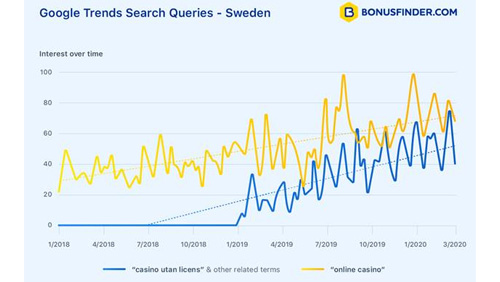
Third of Swedish players search for ‘unlicensed casinos’, research finds

Bonusfinder.com data finds ‘channelisation’ strategy failing and growing numbers of players looking for black market sites

– Warning to German regulators to reconsider recent restrictive proposals

­­30th March 2020 – Almost a third of Swedish players are searching online for ‘unlicensed casinos’, with growing numbers turning to black-market brands due to the market’s restrictive gaming regulations, according to data produced by customer-first affiliate brand Bonusfinder.com.

Research carried out by BonusFinder.com monitoring the Swedish market since it regulated in January 2019 has uncovered a spike in Swedish players searching for a basket of black-market keywords.

WhichBingo Releases 2020 Annual Report Outlining the State of the UK’s Online Bingo Market

The report highlights a wealth of statistics about the online community including demographics, spending and playing habits, as well as perceptions of regulation

[London, U.K., March 23, 2020] – WhichBingo, the U.K.’s number one, independent online bingo reviews website owned and operated by XLMedia, today issued its fifth annual online bingo report outlining the state of the U.K.’s online Bingo market. The report highlights a wealth of statistics about the online community including demographics, spending and playing habits as well as perceptions of regulation. The impact of regulatory headwinds on the industry revealed that the majority of users want responsible gaming tools that abide by regulations and safeguard their experience.

In 2019, regulatory changes imposed on, and operator-led initiatives taken by, the online gambling industry limited advertising windows, established tighter money-laundering prevention requirements, and enacted more stringent checks aimed at preventing a rise in problem gambling. As a result of these checks, bingo operators focused yet further on consumer needs and safety, which had a positive response from users. The most popular feature utilized was establishing spending limits, with seventy percent of those surveyed relaying that they had now set-up deposit limits to ensure they played responsibly.

“We are confident that the success and popularity of online bingo will continue to grow throughout 2020,” said Stuart Simms, CEO of XLMedia. “The emphasis placed on producing quality content and providing value for our users has been at the core of WhichBingo’s success in 2019. In 2020, we will be doubling down on this approach, as well as actively harnessing artificial intelligence and machine learning to further personalise the bingo experience. We will also continue to help brands adapt and meet new guidelines as further regulation in the market helps create long-term sustainability and greater profitability, and an enhanced overall experience for users.”