Category Archives: Esports

Macau’s VIP gambling crunch provides new opportunities for scammers

Macau’s gaming-related crime may be on the wane, but the struggling VIP casino gambling market is still providing opportunities for criminal scammers.

Last month, Macau’s Judiciary Police (PJ) released its crime statistics covering the first half of 2020, during which a total of 4,691 criminal investigations were opened, nearly one-third fewer than the first half of 2019.

The H1 report was unique in that it failed to include any statistics regarding crimes associated with Macau’s gaming industry. The PJ justified the omission by stating that “the statistics on crimes involving the gaming industry in the first half of 2020 are not representative” due to the dramatic reduction in the number of gaming tourists due to the COVID-19 pandemic.

That said, the PJ noted that there were only 29 kidnappings in H1, a nearly 83% reduction from the same period last year. Many Macau cases of forcible confinement involve gamblers who took out ill-advised loans from sketchy figures who then hold them for ransom from family and friends on the mainland. Loan-sharking and fraud cases were also dramatically reduced, falling 83% and 25%, respectively.

Poker in Print: Die with Zero (2020)

It’s tempting to write to a captive audience during something as serious as a global pandemic. If you’re penning a mystery, then making it apocalyptic could be the temptation, after all, readers will know exactly where you’re headed. If you’re writing a poker book, it might be a bestseller if you focus on how to make the most of a dwindling bankroll as real-life costs and day-jobs fluctuate.

That’s not the case with this week’s Poker in Print subject, however, as Bill Perkins’ Die With Zero makes the case for how you should be trying to lose all your money before you leave this world. Well, sort of.

Bill Perkins is not only a fascinating guy, but one of poker’s most charismatic players. If you’ve never watched him play, it might be fair to say that you’re out of the loop when it comes to high rollers, as Perkins is loaded and not afraid to mix it with the big boys, even if his poker resume is slightly less impressive than his business one.

Perkins has cashed for over $5.4 million in live events, yet has only cashed 10 times in his lifetime, in numbers terms that can’t be ideal for the kind of buy-ins he plays. Yet he is a highly talented player, finishing 3rd in the 2013 One Drop High Roller event for $1.9 million, 4th in an EPT Super High Roller the year after for another $470,368 and 6th in last year’s Triton Million for Charity event, earning himself another $2.6 million.

Tour Championship odds: FedExCup up for grabs

Odds courtesy of OddsShark.com

The most unusual PGA Tour season in history comes to an end this weekend from East Lake Golf Club in Atlanta with the Tour Championship. The winner of the tournament also takes home the FedExCup and its $15 million grand prize. Only the Top 30 in points after this past Sunday’s BMW Championship qualified, and with such a tiny field there is no cut.

Normally, golf falls off the map for casual bettors following the Tour Championship with the start of football season. The PGA Tour then starts its next wraparound season with the fall series events, which are somewhat lower tier and rarely draw the game’s biggest stars. However, in this coronavirus-altered year, the U.S. Open and Masters are still to be played (technically part of next season now) so the likes of Tiger Woods, Phil Mickelson and Rory McIlroy will still be competing. Neither Tiger nor Phil qualified for the Tour Championship, though.

The Tour originally set up the FedExCup playoffs where the Tour Championship winner probably would also win the FedExCup, but a few times there was little drama because the Tour Championship winner didn’t win the Cup.

Donaco casinos take FY20 beating, FY21 uncertain

Asian casino operator Donaco International took a beating in its most recent fiscal year and isn’t making any forecasts for the year ahead.

On Monday, the Australian-listed Donaco reported that it had booked a net loss of AU$59m (US$43.5m) in the 12 months ending June 30, a significant improvement over fiscal 2019’s AU$198m loss. Group revenue declined 38% to AU$53.5m while earnings slipped nearly two-thirds to AU$10.3m.

Donaco attributed the bulk of the net loss to a non-cash impairment charge of AU$50.5m after downgrading the value of the gaming license at its main Star Vegas property in Poipet, Cambodia. The company took the hit based on the uncertainty surrounding Star Vegas, which closed in April due to COVID-19 and hasn’t yet received Cambodia’s permission to reopen.

Star Vegas, which accounts for around three-quarters of Donaco’s operations, reported FY20 revenue falling 45% year-on-year, while earnings tumbled 63% and net profit after tax slid 54%. VIP turnover slipped 45% due to “increased competition in Poipet and the emergence of unregulated gambling.”

Flutter’s flight from Asia is just the beginning

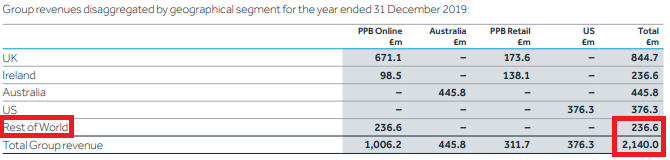
It’s hard to hide my exasperation at financial markets right now, especially in the United Kingdom. They make no sense. Take Flutter, for example. It just lost a big chunk of its revenues after fleeing unregulated markets in Macau, Taiwan, and China, and it’s only down 1.3% today, still near all time record highs. It’s another sign that deglobalization continues apace and governments are getting more insular and cranky while their revenue streams dry up. It’s impossible to know exactly how much revenue Flutter is losing in this sad retreat. It could be as much as 11% of total sales, but we just won’t know until the next annual report. I say 11% because of this table from page 122 of Flutter’s 2019 annual report.

(Those super exquisite red boxes are my own addition. *Takes Bow*)

 Nowhere in Flutter’s annual report do the words “China”, “Macau”, or “Taiwan” even come up. Best not to bring too much attention to these grey markets unnecessarily. Not that I’m against operating in unregulated markets. Offering gaming services to people who want to play promotes peace and cooperation. It’s just that investing in grey markets isn’t exactly my cup of Earl Grey. They may be lucrative, but only so long as governments and their bureaucrats remain fattened and sedated by their existing tax revenues enough to look the other way. Once the power brokers at the top get frazzled and worried, the chain of hassling from the top down gets activated. Bureaucrats get antsy and aggressive, fearing for their own livelihoods, and grey markets get shut down.

Maybe this is a big loss for Flutter. Maybe it isn’t. The bigger picture though is that this exit is just the beginning, and Flutter will not be the only victim by any means. We are going to see a swell of exits from all kinds of grey gaming markets all over the world in the coming months. Companies heavily reliant on revenues from these places are going to get smashed. (Except for GVC of course, which never goes down.) Unfortunately, the crackdown on grey markets will likely hit gaming companies first before other industries get lined up before the firing squads, because of course the gaming industry is the whipping boy for tax increases when regimes get desperate.

Fighting financial fair play – Can Chelsea sign anyone else?

It’s already been a very busy summer transfer window for Chelsea Football Club. Led to 4th place in last season’s pandemic-extended Premier League, Frank Lampard has doubled down on signings.

Last season, of course, Chelsea’s pre-existing transfer ban decried that the West London club, famous for spending the rubles of Chairman Roman Abramovich, were unable to splash the cash like they had a reputation for doing before. Mateo Kovacic came in on a permanent deal, but the loss of Eden Hazard meant youth had to be given a chance. Christian Pulisic apart, Chelsea relied on homegrown talent in key areas, with the development of players such as Hudson-Odoi and Abraham key to their success.

This year, a different approach has been taken, with the signings of Hakim Ziyech (£30m), Timo Werner (£45m) and Ben Chilwell (£50m from fellow top four challengers Leicester City) proving that Chelsea have returned to wanting fully developed players with an established reputation rather than unproven yet more youthful talents that can grow at Stamford Bridge.

With the imminent arrival of Kai Havertz in a deal which could cost around £90 million, financial fair play rules seem to dictate that Chelsea’s spending, while currently inside the boundaries of FFP that are permitted, is bound to be over.

New crypto regs in the UK to help provide more support to gaming space

The concept of cryptocurrency being nothing more than a “fad” is rapidly being dissolved. Regulators and lawmakers across the globe are taking the issue of a digital currency world more seriously, and no one could legitimately argue now that, in the very near future, crypto will be a regular part of a monetary system. What role it will play may still be open for debate, but a recent policy change on the part of U.K.’s financial regulator, the Financial Conduct Authority (FCA), shows how far things have come in just a few short years, and how the crypto space is continuing to evolve. Going forward, anti-money-laundering (AML) laws that have been in place for conventional currency businesses will be applicable to all companies working in the crypto space. 

This is a huge step forward for crypto industry, with the FCA leading the charge to bring digital currency to run parallel to existing fiat alternatives. The policy reform will give the regulator the ability to more closely monitor activity occurring in the crypto realm, which is going to help reduce the AML risk and continue to clean up the industry. It is also a great way to ensure better integrity and transparency among those businesses involved in crypto as a payments solution. 

The new initiative will require crypto businesses to submit AML reports, just like conventional fiat currency businesses do, and show how they are working to curb the use of crypto for money laundering or other nefarious purposes. The FCA is only just now exploring the option of expanding its reach to the crypto sector; however, there is little doubt that it will succeed, given the greater emphasis that continues to be placed on the monitoring and adoption of digital currencies as a payments alternative. 

One goal of the policy, should it be implemented, is to give the FCA substantial amounts of data pertaining to crypto operations, which will lead to even more guidance and control, traits that will help the industry continue to rise. Overall, the expansion of the AML policy to the crypto sector will see the regulator receive data on as many as 4,500 crypto entities annually, which will go a long way toward building a more robust, legitimate industry.

Gambling Industry Announcement and Partnership Roundup – September 1, 2020

In the fast moving world of gambling, sometimes you might miss news that could be important to you. To make sure you’re all caught up on gaming industry news, be it online or brick and mortar, we’re rounding up the some of the announcements and partnerships from the last week that you might have missed.

Don’t miss out on all of the latest announcements. Our Press Release section is updated constantly.

GrooveGaming constructs major contract extensions with BetConstruct

Aggregator GrooveGaming has announced a milestone contract extension with gaming and sports betting technology solutions provider BetConstruct. 

New York Gov. teases good news coming for casinos ‘next week’

New York’s casino industry might finally be ready to reopen. Gov. Andrew M. Cuomo has now hinted that the state’s casinos may be allowed to reopen soon.

Cuomo made the suggestion while on a conference call with reporters on August 30. “We will have an announcement next week,” the governor said. “It is going to be positive news.”

No further details were provided, so an exact time table for when casinos will be allowed to reopen will have to wait. Cuomo emphasized that casinos and racinos are still considered non-essential, and safety from the Covid-19 pandemic still comes first. “I understand their point, I understand their economic reality, I understand the feeling that you see other places opening up but you still can’t go back to work,” Cuomo said.

Operators saw this as promising news. Jon Schneider, spokesman for Suffolk OTB, operator of Jake’s 58 in Islandia, doesn’t know exactly what Cuomo has planned. But Jakes’ 58 will be ready if given the green signal. “Based on what the governor said, we are optimistic,” Schneider said

San Jose, California considering outdoor casinos

Allowing large crowds to gather in interior spaces has become taboo because of the coronavirus. This makes it difficult for many businesses, including casinos, restaurants, movie theaters and others, to make a living. An alternative, at least until things return to normal, is to allow certain activities to take place outdoors where feasible. A number of cities across the globe have introduced outdoor dining and some places have toyed with the idea of outdoor casinos. Weather and safety are always a concern, but a city in California is expected to vote on a measure today that would allow its gaming activity to be moved outside, although San Jose residents may try to shoot the initiative down. 

The San Jose City Council is expected to take a vote today on whether or not the Bay 101 and Casino M8trix, the city’s only two gambling facilities, should be allowed to operate outdoor casinos for the time being. The working idea is that the properties could put up massive tents and install certain gaming equipment inside, thereby better fulfilling social distancing and other health protocols. It’s seen as a win-win-win, as the casinos get revenue, the city gets revenue and the locals get a much-needed distraction. 

San Jose is missing out on a serious amount of revenue with gaming facilities still shuttered. According to Raul Peralez of the City Council, “Currently, our city’s emergency order allows for a diverse array of business sectors to operate outdoors including now personal care businesses and retailers. However, permitted cardrooms, which in 2018-2019 generated $18.9 million in tax revenue, are not included in this list and that is a missed opportunity.” He adds, “With an estimated $100 million deficit looming over our city for the next two years, the city should leave no stone unturned when it comes to creating desperately needed tax dollars for our community.”

There are a lot of components that are needed to pull off a successful outdoor casino, including enhanced security, as well as deciding on which locations would best serve the market without impacting the surroundings. Anytime changes to a casino-tied issue are requested, there are those who reject the idea if for no other reason than they have nothing better to do. However, with the city facing a major budget shortfall, allowing any business segment to reopen in any capacity is beneficial.

Rhode Island sees its sports gambling market climb toward recovery

There’s still a lot of work to be done, but Rhode Island’s sports gambling market is bouncing back to life. Thanks to a move by the state’s governor, Gina Raimondo, in-person registration is now no longer a requirement, making it easier for sports gambling fans in the state to participate in the activity, and this is going to help things return to normal. Even though the requirement was only lifted on July 22, and the state’s sportsbooks were closed for most of the month, July’s handle jumped 231.5% from the previous month and, with the NFL season quickly approaching, things will only get better.

In July, Rhode Island’s sportsbooks took in $6.73 million, a considerable increase over the $2.03 million they reported a month earlier. The figure, however, still pales in comparison to the $8.32 million the sports gambling operators reported in July of last year, but that’s not surprising, given the state of sports activity that month. The NBA, the NHL and MLB were only getting back into a groove at the very end of that month, and the absence of the major sports leagues didn’t leave many options for gamblers. In addition, the sportsbooks didn’t begin to reopen until July 22, two weeks after the casinos had been allowed to restart their operations.

Mobile sports gambling in the state, as has been the case everywhere it’s allowed, continues to be the star of the industry in Rhode Island. It accounted for $4.4 million of the handle, a 109.5% increase over June’s figure. A year earlier, mobile sports gambling wasn’t even allowed in the state, so there’s no year-on-year comparison, but the amount accounted for 65.4% of the overall handle.

Before on-line registration was approved in July, gamblers had to travel to one of the two casinos in the state, Twin River Casino Hotel or Tiverton Casino Hotel. As lawmakers watched the revenue coming in from sports gambling disappear, they launched an initiative to remove the in-person registration requirement, which was quickly approved by Raimondo. However, the market is still extremely limited, with gamblers only given a single online option that is run through SportsBetRI, an entity controlled by the state’s lottery.

Bodog sportsbook bullish on basketball and baseball bets

The NBA Bubble at Disney World in Orlando, Florida has worked more efficiently and safely than most major corporations around the world. That says a lot, given the limited amount of time the league had to put everything together. With the playoffs now underway and Round 2 beginning, there is a lot to look forward to, and sports gambling fans haven’t been wasting any time grabbing a piece of the action. Yet again, NBA wagers are on top at the Bodog sportsbook, but MLB is right on its heels. 

This past weekend, Bodog saw 34.76% of its wagers targeting NBA games, with MLB wagers only a little behind at 34.35%. There were a couple more basketball games on tap for the weekend after teams boycotted last week following another police-involved shooting of an unarmed man, which forced a couple of games to be shifted to the weekend. Had it not been for that, it’s possible that MLB wagers would have unseated the NBA from its first-place position on the charts. 

The NHL, which is now running the Stanley Cup playoffs, was on the list, as well, but only captured 7.66% of the bets. This will most likely change now that the race for the championship is much deeper, and the hockey league should grab more of the action next weekend. Included among the top ten targets for sports gamblers on Bodog this past weekend, the Ultimate Fighting Championship grabbed 5.1% of the action, the PGA Tour’s BMC Championship saw 4.12% and, a little surprisingly, table tennis jumped into sixth place, receiving 3.51%. Sports gambling fans also put down some money on WNBA games, NFL 2020 Sims, the ATP Tour and, with just 2.2% of the wagers, MLS. 

Despite the fact that the NBA and MLB were neck-and-neck in the race for wagers on Bodog this weekend, individual NBA games captured all top ten spots in terms of individual contest wagers, except one. In sixth place, the BMW Championship accounted for 9.33% of the action, thanks to an awesome battle between Jon Rahm and Dustin Johnson. Both golf pros were on fire, sinking a number of shots that almost seemed impossible, including a 66-footer by Rahm that took almost a 90-degree turn into the cup. That was on the 18th hole, and followed a 45-foot birdie by Johnson that forced a playoff between the two. Rahm would go on to win, bouncing back from six-over-par after two rounds. That gave him bragging rights for the best 36-hole recovery leading to a championship in 40 years. 

Casino, online gambling proposes by Thailand MP

A Thai lawmaker has discovered that if you legalize gambling, the government can make a buck off of it. But just as Mongkolkit Suksintharanon has begun proposing a legalized scheme for his countrymen to gamble in, allegations of corruption could bring him down.

Mongkolkit, leader of the Thai Civilized Party and a party-list MP, has suggested on August 31 Thailand construct its own “Entertainment Complex.” Ideally, such a complex would have a casino, hotel, theme park, and other entertainment facilities. Prefering the complex to be built next to a tourist destination, like Bangkok or Phuket, Mongkolkit specifically sees the idea as a way to gain new tax revenues.

But he also implied an expansion into online gambling “There are many online gambling websites running in foreign countries for Thai people,” Mongkolkit told the press. “The websites were running legally while it was illegal for Thai gamblers to play. There is also no taxation charged for gamblers and the Revenue Department is still confused about the law since it is ambiguous.”

“Therefore, it is also recommended that taxation should be charged from online gambling websites for about 5-6 billion a year,” he said. “Since Thailand currently has insufficient income from tourism and exports, the government should consider legalizing what is illegal and bringing the tax into the country. This should be useful for the whole country.”

Playson inks content deal with SNAITECH

Leader within Italy’s legal gaming market to bolster its casino games offering.

Malta, 31st August 2020 – Casino software provider Playson has announced a partnership with SNAITECH to roll out its full suite of slots across the Italian operator’s online and mobile offering.

SNAITECH’s Italian player base will have access to games such as Solar Temple, Solar Queen and Pearl Beauty: Hold and Win, along with the popular Timeless Fruit Slots series and its Funky Fruits portfolio.

The deal also gives the operator access to Playson’s integration-free engagement tools, including free spins, jackpots and regular network tournaments, all proven to drive player engagement rates.

Tipsport has drastically improved its esports offering thanks to Oddin

Engaging esports odds feed and risk management provider Oddin and Tipsport have recently shared the fruitful outcome of their collaboration.

“For Tipsport, the average age of a new bettor that we onboard through esports is 25 years. For all other sports, excluding MMA (which is 28 years) the average age is 33+ years“, declares Daniel Vesely, Head of Esports at Tipsport. “There is a clear value for us in attracting the younger generation through esports. Given that our esportsbook has been at least doubling each year, it was about time to elevate our offering and bring it to the next level.”

“Tipsport is a perfect example of what a traditional sportsbook can achieve within esports with a strong focus on engaging live product.” said Marek Suchar, Head of Partnerships at Oddin. “From the very beginning, they made it clear that the live betting opportunities, with a focus on uptime and number of live markets, is their core competitive advantage in all the sports they do and they aspire to achieve the same in esports. There was a clear understanding of this vision from both sides so our partnership was a no-brainer.”

“With the engaging solution from Oddin, we were able to multiply the number of live markets by 6 and increase the uptime by 47% which resulted in an increased volume of 35%“, said Mr. Vesely. “The results have actually been better than we hoped for. We were also surprised that Oddin was able to triple the portion of side market volume to 27%, as usually you see the split of 90/10 in favor of winner`s markets. There is definitely space for further engagement of esports bettors to bet on more in-game objectives. Oddin has shown us hard figures and we are confident in our long-term partnership due to their capacity to constantly innovate.”

Macau may be open for business, but casino revenue still nonexistent

Macau, once a popular destination for international gamblers looking for a unique, diverse setting for their favorite activity, is trying to claw back after being hit hard by the coronavirus. The global pandemic hit the city hard due to its reliance on casinos and betting for much of its revenue, and Macau has suffered serious setbacks after being shutdown for extended periods of time in an effort to keep the virus from taking over. Any belief that a relaunch of the casino market would help the city bounce back quickly has proven to be misguided and, according to the latest figures from the Gaming Inspection and Coordination Bureau (DICJ, for its Portuguese acronym) show that there is still a lot of work to be done. Macau’s gross gaming revenue (GGR) for August was almost 95% lower than it was a year earlier, marking an eleven-month trend in poor performance in the local casino industry.

The DICJ reports that the GGR in August was just $166 million, down 94.5% year-on-year. This mirrors the results seen a month earlier, when Macau only took in $167 million, also a year-on-year drop of 94.5%. For the past five months, the GGR in the city has been more than 90% lower than it was a year earlier and, for the past eleven months, gaming revenue has been in a downward spiral, with the city seeing 80% less gambling revenue over the period compared to a year earlier. Across the first eight months of 2020, GGR is off by about 81.6%, having dropped to $4.55 billion from the $24.78 billion Macau reported in the same period in 2019.

There’s improvement coming, even if it won’t put things back in place quickly. The Individual Visit Scheme (IVS), a program that gives Chinese nationals easy access to Macau, had been stopped this past January because of COVID-19. Residents of Zhuhai in the Guangdong province, a major feeder for Macau, were allowed to apply for an IVS again as of August 12, but the scheme was restricted elsewhere in the country. Now, the rules are being relaxed and, after seeing how things go with the rest of Guangdong, which was given approval to submit IVS requests as of August 26, China could open the IVS program to other cities on September 23.  The first Guangdong-wide IVS requests are expected to be approved today.

An 11-month 80% drop in revenue is enough to cause a serious amount of stress on anyone. Fortunately, the Macau government has been smart over the years with its money and should be able to keep itself alive as it works to overcome the losses. Plans to diversify the city and make it more versatile in terms of being an international tourist destination had already begun prior to the coronavirus pandemic, and will certainly be stepped up now. 

UK Tote Group appoints John Williamson as Chairman

The U.K. Tote Group is today delighted to announce the appointment of John Williamson as the Group’s Non-Executive Chairman from 1st September 2020.

Ten months after the U.K. Tote Group’s acquisition of the Tote, the U.K.’s leading pool betting operator, and at a key time for both the Group and British horseracing, Williamson’s appointment brings significant international business and financial expertise to the organisation and its ambitious growth plans.

Alex Frost, Chief Executive of the U.K. Tote Group, said: “We are delighted to be welcoming someone of John’s calibre and expertise as the new Chairman of the U.K. Tote Group. John’s broad international experience in global finance and business, his track record in guiding international brands and operations, notably more than a decade on the board of Asia’s leading stock exchange, HKEX, and his expertise in working in multi-stakeholder complex organisations will be invaluable to us and to British racing. His extensive experience in Asia, in particular, will support our ambitious programme to expand our partnerships with other global pool betting organisations around the world, a cornerstone of our growth strategy for the Tote. We are thrilled that John is joining us, and we very much look forward to working with him.”

John Williamson said: “I am a keen racegoer and have long admired the outstanding work of the Hong Kong Jockey Club, running two world-class racecourses, and operating the world’s largest sports wagering business. My dual enthusiasm for racing and business, alongside being able to provide an international perspective will, I hope, be of considerable value to the U.K. Tote Group team and to British horseracing, and I am very much looking forward to working with the team as they drive forward their growth ambitions.”

Transitional regime for German online gambling operators? Learn more at the Gaming in Germany

In recent weeks, the German states of Bavaria, Hamburg, North Rhine-Westphalia, and Berlin have been preparing the ground for the introduction of a transitional regime for German online casino and sports betting operators.

According to a draft resolution that has been circulated among the states, “[O]perators shall be offered a transition to the regulations of the GlüStV 2021 to the extent that they actually already today adapt their business practice to the expected future legal situation and limit their offer accordingly. The operators must guarantee to comply with the already technically feasible requirements for player protection and the fight against gambling addiction.”

In exchange for compliance with future regulations, enforcement against unauthorized gambling offers will be redirected to “those operators who are likely to evade future regulation.”

According to the latest proposals, operators will have until October 15 to comply with the transitional regime – provided enough states decide to accept the draft resolution.

British Columbia’s online gambling up one-fifth to record C$179m

Online gambling revenue in the Canadian province of British Columbia enjoyed a record surge in the most recent fiscal year even before COVID-19 shut down land-based options.

On Monday, the British Columbia Lottery Corporation (BCLC) issued its annual report for the 12 months ending March 31, during which the Crown Corporation generated revenue of C$2.53b (US$1.94b), a 2.2% decline from fiscal 2018-19’s total. Net income fell 4.8% to just under C$1.35b.

BC closed its casinos in mid-March due to COVID-19, but this only negatively impacted the fiscal year’s final month. Nonetheless, BCLC’s ‘Casino & Community Gaming Operations’ reported revenue of C$1.83b, down 3.7% year-on-year, while net income dipped 5.5% to C$929.3m.

Slot machine revenue fell 2.3% to C$1.37b while table games fell 8.1% to C$417m. The table decline is slightly larger than the previous year, suggesting that the province’s post-scandal efforts to more properly observe anti-money laundering (AML) compliance continue to act as a drag on revenue.

Imperial Pacific loses $103m, accuses CNMI of reneging on casino exclusivity

Saipan casino operator Imperial Pacific International (IPI) threw another $103m onto the bonfire in the first half of 2020, while questioning the definition of ‘exclusivity’ in order to get out of paying its license fees.

On Monday, IPI released its interim results for the first six months ending June 30, during which revenue fell 93.3% year-on-year to just HK$26.7m (US$3.4m). The company booked an operating loss of nearly HK$53m while its actual losses hit HK$798m (US$103m).

Believe it or not, that’s actually a significant improvement over the nearly US$240m the company lost in H1 2019, and the improvement came despite IPI being forced to close its Imperial Palace casino in mid-March due to COVID-19. Perhaps IPI should choose not to operate any gaming whatsoever in the second half of 2020 in the hopes that it might break even.

IPI’s once vaunted VIP gambling business booked a net loss of HK$24.7m in H2 versus a HK$255m gain the previous year. Mass table game and electronic gaming revenue each fell by two-thirds to HK$32.8m and HK$12.8m, respectively.